



It trades. You watch.
Nobody touches your money.
It trades on paper today. Real money when it has earned the right. Every call, every flop, in the open.
Built for individual retail traders with their own exchange account, not for funds, prop desks or anyone who wants a promise of making money.
First come, first served, until real-money trading goes live.
Fear. A reading of news tone, not a signal.
Five steps to a first trade
No card to sign up. Nothing real trades until launch.
Sign up free
Sign up in a minute. No card needed.
Pick a package
Get in first with a pre-order package. Plans start when live trading opens.
Link your exchange
Add a trade-only API key. It can never withdraw.
Set your rules
Pick a strategy, a budget and a stop-loss.
Start trading
Practise with paper trading. Live trading opens at launch.
Signing up takes a minute and asks for no card. You get a free paper account the same day, on real market prices with pretend money, so you can watch what the bots do before you trust them with anything.
When you want more, you pick a pre-order package and set the rules your bots must live by (budget, stop-loss, the coins they may touch). When key linking opens, you link your exchange with a trade-only key. Until launch, everything stays on paper: every decision written down, nothing sent to a real order book.
Real-money trading opens at launch, and not a minute before, for everybody, including us. Changed your mind? Nothing is charged to sign up, and a key you delete at your exchange is dead on the spot. Leaving is as easy as arriving, which is how it should be.
How Kestrel decides
A reader, a gate, your rules, then the Talon.
Most bots have one opinion and a lot of confidence. Kestrel has a chart reader that has to show its working, a gate that says no far more often than yes, an exit that has to cover its costs before it locks anything, and your rules standing in front of every order like a bouncer with a clipboard.
Here is what runs today, on paper. All day, as setups appear, Kestrel's chart reader reads the strongest markets it watches and writes a call: long or short, the horizon, how confident it is, the entry, the stop, the target, and the one price that would prove it wrong. It writes its reason in five languages, and you can read every one on the Eye.
Separately, we are training our own market model from scratch on years of exchange data. Its first run has ended, a new run trains from zero, and no version has passed its tests yet. When one does, it joins on paper beside the reader. Not before, and not quietly.
- Chart readerNews reader
- Both agree?No: nothing happens
- Your rules
- Your exchange
- The Talon
The chart reader
The chart reader looks at each coin across several timeframes: the trend, the moving averages and their slope, momentum, the recent highs and lows, where the price sits against them. Then it commits, in writing: which side, for how long, with what confidence, and where it is wrong.
That last part matters most. Every call carries its invalidation, a price that, if the market closes past it, means the idea was wrong. A call without a "this is where I am wrong" is a vibe, and vibes do not get past the gate.
It reads all day and it never gets bored, which is more than we can say for ourselves. It also has no favourite coin and no memory of being right last week, which is the point.
The news reader
Prices move because people act. The news reader reads exchange notices, regulators, publishers, status pages and official accounts as they publish, and gives the market and each coin a mood and an urgency.
The change matters more than the level. People being gloomy about any one coin for months is not news. People turning gloomy this morning is. The mood you see across the site is that reading: a measure of news tone, never a signal, and it never opens a trade on its own.
Where it does act is on the brakes. Urgent bad news about any coin, an outage, a delisting, a hack, a regulator, blocks new longs on it. It does not close a trade that is already open.
The gate: worth it after costs, or nothing happens
A call is not a trade. Before anything happens on paper, the gate asks a rude question: is the move this call expects big enough to pay for itself? Fees on both sides, the spread, slippage and funding all come out first, and the expected move has to be at least one and a half times those costs.
Most calls fail that question, and that is fine. Sitting out costs nothing, and "no trade" is the most common thing Kestrel does, by a distance. A bot that trades all day is mostly paying its exchange.
The record keeps the calls that did not pass too, so you can see what it looked at and why it said no.
Your rules, on every order
When you run bots of your own, your budget, your stop-loss and your coin list are checked before every order, every time. It never trades outside them. Not negotiable, not even with itself.
Spending caps, loss limits and a stop button sit beside them. Press stop and it stops; there is no clever argument it can make to carry on.
Kestrel's own house book lives under rules too, set by us and shown on the Kestrel page: how much of the account any one idea may risk, and how many trades it may hold on one coin. They are written down, and they change only through the weekly review.
Hover: an entry on trial
Today the main book enters at once, when the price is within 0.1% of the call's entry. Hover is a more patient rule on trial in its own lane: it waits for the price to show a direction before it fills, and stands down within the hour if it never does.
Buying the instant a call appears pays for every call the market ignores. Hover makes the market show its hand first. Whether that beats entering at once, after costs, is what its lane is there to find out.
Reflex, a second entry lane trained on entries simulated from past market data, did worse than Hover in its own backtest, and it says so in public. Both stay in testing.
The Talon: how it gets out
Getting in is half a trade. The Talon is the exit every Kestrel trade uses, and its rule is published. It arms only once the price has covered the round trip: fees on both sides, slippage and funding. Until then the call's own stop stands.
Once armed, it climbs a ladder: a rung at each step of the published rule, each one a level the trade will not give back. On top of the rungs it banks money locks as the position's gain grows. Each lock sits a little under the price, with room for that coin's normal noise, so an ordinary wobble does not throw you out of a good trade.
It never loosens. The trade closes when the price falls back through the last lock by more than that room, or reaches the stop. Then the record writes down what was left after costs, a win or a loss, in the same ink either way.
An example, start to finish
An illustration, not a trade. The chart reader calls one coin long on the 4-hour: price above a rising average, a recent low as support, a target 3% up, and "wrong if it closes under the support". The expected 3% clears the costs by enough, so the gate lets it through.
The entry rests at the call's price and fills on paper as soon as the price is within 0.1% of it. Say the round trip costs come to 0.2% of the entry. The Talon waits until the price is 0.3% up, one and a half times the costs, then arms and starts locking as it climbs.
Now two endings. One: the price runs, the Talon locks rung after rung, the price slips back through the last one, and the trade closes with what was locked, minus costs. Two: the price never gets to 0.3%, turns, and hits the stop. That is a loss, and it is printed exactly as large as it was. Both happen. The record has plenty of each.
- Does not sleep. Does not get bored. We checked.
- Writes down where it is wrong before it starts.
- Says no a lot. That is the point.
Questions about how it decides
Does Kestrel trade real money today?
No. Everything today is paper trading: real market prices, pretend money. Real-money trading opens at launch, for everybody at once, and only after a version has passed its tests after real costs, on months it never saw, approved by a founder.
Is the trained AI model making the calls?
Not yet. Today's calls come from the chart reader, through the gate and the Talon. Our own market model is in training, and no version has passed its tests. When one does, it is added on paper beside the reader, and the changelog says so the same day.
Can it trade outside my rules if it is very sure?
No. Your budget, stop-loss and coin list are checked before every order. Being sure is not one of the ways round them, because there are none.
Where can I see the Talon work without risking anything?
On the Talon simulator: drag a price path and watch the live Talon arm, lock and close. It runs a copy of the live exit's own code with today's rule; it starts at the fill and moves one price a minute, so a live trade's fills can differ a little.
The live paper account
Real prices, pretend money, losses as plain as wins.
This is the account the bot trades right now, read straight from the paper desk. Real market prices, pretend money, and nothing on this page is picked out or tidied away.
The figure is the cash plus every open position at a fresh price, or at what it cost where there is no fresh price. A loss is printed in the same size and the same ink as a gain, because hiding the bad days is how trading sites earn their reputation.
Beside it sits Kestrel's own record: every paper call it has made, which coin, which side, which lane, what the round trip cost and what was left after it. A past result says nothing about the next one, and we will never pretend it does.
Level with where it started on Sep 27, 2026. Real prices, fake cash.
No trades on this account yet. The first one lands right here.
Every trade on the account, with its reasonKestrel's latest paper calls newest first
- AAVEShort AAVE at 125.6up 0.58 USDT after costsNov 4, 2026 00:34 UTC, paper
- TAOShort TAO at 222.0up 0.58 USDT after costsNov 4, 2026 00:33 UTC, paper
- SOLShort SOL at 92.08up 0.60 USDT after costsNov 4, 2026 00:33 UTC, paper
Questions about the paper account
Is this real money?
No. It is paper trading: real market prices with pretend money, so nothing is at risk. Real-money trading opens at launch.
Why show the losses?
Because they happen. A record that only shows wins is an advert, and this is a record. Losses are printed exactly like wins, and the full track record is one tap away.
Why does it say the account is resting?
When the paper desk cannot be read, the page says so rather than drawing a number. We would rather show nothing than show something made up.
One live book, many lanes
Ideas earn their way in. Most of them do not.
Kestrel keeps one live book: the paper account whose result is the headline. Every other idea we have for doing better runs beside it as a lane, on its own ledger, taking the same calls with exactly one thing changed: a different exit, a maker entry, only one side, one horizon, one exchange.
A lane has to earn promotion. It needs enough trades to mean something, then it has to beat the live book after real costs, and then it waits for the weekly review on Sunday, where at most one rule changes per book per week. Lanes that fail are demoted in public, with their numbers. Today's lanes, and how far each has got, are on the Eye.
Every exchange Kestrel trades on paper also runs as its own book: the same calls, on that exchange's own prices, fees and quote, including Canadian dollar books. They are tagged PROVING and never count in a headline. Each book's trades, wins and losses are on the Eye.
And there will be one lane nobody is allowed to touch: the control. When the rules are frozen, it starts running them as they were, so every change can be measured against something that did not change. If a "fix" cannot beat the control, it was not a fix.
The safety caps
Some limits are structural, not learned, and no clever model talks its way past them. Live today on the house book: at most 1% of the account at risk on any one idea; ONE money leg per idea (the cheapest round trip; the other exchanges' copies are paper proving legs); and one open trade per coin on each exchange.
Being built: a cap on how much the whole book may have at risk at once, a daily loss stop that halts new entries for the rest of the day, and size cut in half after a drawdown from the 30-day peak. They go live when they are built and tested, and the changelog says when.
The scoreboard, honestly
What has been proven so far. Short list.
Here is the sentence most trading sites will never print: no Kestrel lane has yet proven that it beats its real costs over enough trades to call it an edge. Some lanes are up, some are down, and none has passed the bar. We are telling you because you would find out from the record anyway.
The bar is not "it made money last week". It is: after every fee, spread, slippage and funding payment, on trades it never trained on, in rising AND falling markets, over enough independent trades that luck is not the explanation. That is the same test for every lane, every exit change and every model version.
What we have instead is the honest part: a record of every paper call, every loss printed as plainly as every win, every failed idea demoted in public, and a system built so that only what passes gets promoted. Today's numbers are on the record page, straight from the record.
Paper trading exists for exactly this. Better to find out what does not work with pretend money, in public, than with yours.
Questions about the scoreboard
So is it any good?
Not proven yet, and we will not pretend otherwise. The record shows every trade, the lanes page shows every test, and the day something passes the bar, the changelog says so with its numbers.
Why would I pre-order something unproven?
You might not, and that is a fair call. A pre-order buys months of the software at a fixed price, starting at launch; it is not a bet on Kestrel's results and not an investment. The free paper account costs nothing and shows you everything first.
Kestrel trades on air
Every call, every flop, two anchors, no edits.
ATON Kestrel paper trades the crypto market in real time while two anchors explain each move and roast the bad ones. No real money, nothing hidden, and the losses get airtime too.
The same show goes out on every channel at once, so pick your favourite app. This player is a poster until you press it: nothing loads from YouTube before that.
Ask the anchors a question, argue with a call, or just hang out with the community. The status on this card is read from the channel itself: live when it is live, back soon when it is not.
 Discord
 Telegram
While the show is live, this page opens with YouTube's privacy-enhanced player, muted. Otherwise nothing loads from YouTube until you press play. Paper trading with pretend money. Nothing on the stream is financial advice.
Open the stream pageQuestions about the stream
Is the stream financial advice?
No. It is paper trading with pretend money, and nothing on the stream is financial advice. It is a show about a bot learning in public.
When is it on?
This card reads the channel and says live or back soon. We do not print a schedule we cannot keep.
Your money stays yours
It can trade in your account. It can never take money out.
Atheron never holds your money. It stays in your own account at your own exchange, and Atheron trades there with a key you make: a key that can place and close orders and can never withdraw.
That is what non-custodial means, and it is enforced by the exchange, not by a promise from us. There is nothing in the key to run off with.
Want it to stop? Delete the key at your exchange and it stops, mid-sentence if it has to. No ticket, no phone call, no asking us nicely.
Trade-only access
The key it uses can trade. Withdrawals are blocked, and the exchange is the one blocking them.
Off in one click
Delete the key at your exchange and it stops. You never have to ask us first.
Keys stay with you
When key linking opens, a key you save on the web is encrypted and only the trading engine can unseal it; with the desktop app, when it ships, it stays on your own computer and nowhere else. No Atheron screen can show a key, and the apps never ask for withdrawal permission.
Hard limits
Your budget and stop-loss are checked on every order, before it goes anywhere near the exchange.
Exchanges at launchYour account, your key. Kestrel already paper trades on more exchanges than this; each joins the list when it is ready for your key.




Some exchange links are our invite links. We may earn a referral reward when you sign up, at no cost to you.
Questions about your money
Can Atheron withdraw my money?
No. The key it asks for has trading permission only, and withdrawals are blocked at the exchange. Atheron holds none of your money.
How do I stop it?
Press stop, or delete the key at your exchange. Either way it stops, and nothing can trade in your account until you make a new key.
What it costs
Pre-order packages, priced for where you live.
Each package is one payment. It includes free months of a plan, and those months start on go-live day, the day real-money trading opens, not the day you pay.
Prices are set for your country and shown in Canadian dollars, plus tax. After the free months, most packages keep a discount on their plan for life; the entry package keeps nothing after its months, on purpose.
A pre-order buys months of access to software at a price fixed in advance. It is not an investment, not a security and not a share of anything.
Frostbyte
$69CAD plus taxone payment2 months of Arctic
Permafrost
$207CAD plus taxone payment6 months of Arctic, then 20 percent off for life
Deep Freeze
$557CAD plus taxone payment12 months of Aurora, then 30 percent off for life
Absolute Zero
$2,119CAD plus taxone payment10 years of Aurora, then 50 percent off for life
Superfluid
$2,977CAD plus taxone payment24 months of Borealis, then 55 percent off Borealis for life
Plans from go-live, a monthGlacier $34CAD plus taxArctic $98CAD plus taxAurora $207CAD plus taxBorealis $295CAD plus taxPolaris quoted
Prices for United States. Band A, full price, set against the World Bank income classification, which is published and revised every year. Your band follows your country of residence and is confirmed when you buy. It does not change because you are travelling.
You can lose money, including all of the money you put at risk.
Questions about the price
When do my free months start?
On go-live day, the day real-money trading opens. Paying today does not start the clock.
Why is the price different for me?
Prices are set for each country, so the same package costs what it should where you live. The page shows the price for where you are.
Is a pre-order an investment?
No. It buys months of access to software. Its value does not move with how the business performs, and it is not a share of anything.
Each name and mark belongs to its owner and is shown to say which venues the platform connects to. None of them sponsors, endorses or is affiliated with this product. Availability is set by each venue and by where you live, and can change without notice. Some exchange links are our invite links. We may earn a referral reward when you sign up, at no cost to you.
Not built yet
Dotted means promised, not shipped.
Some of this is still a drawing. We would rather show you the dotted lines than let you find them, so here is what is promised and not shipped.
Each one moves to the changelog the day it ships, and the roadmap shows where it stands now, live from the build tracker. Dates are our best estimate, and if one moves we will say so.
The renderings below are the coming platform as it is drawn today. Nothing loads until you press one, and none of them is a promise of a date.
Desktop app
Windows, macOS and Linux. Your key never leaves your computer.
More exchanges
The exchanges you can connect at launch are on the Exchanges page. Kestrel already paper trades on more than that; each moves into the list when its connection is built and tested.
Real-money trading
Opens at launch, after the paper account has earned it.
The trained market model
In training from zero after its first run ended. It joins on paper only after it passes its tests.
The daily loss stop
A cap that stops new entries for the day after a set loss. Being built; the changelog says when.
The platform
What is coming, drawn in motion.
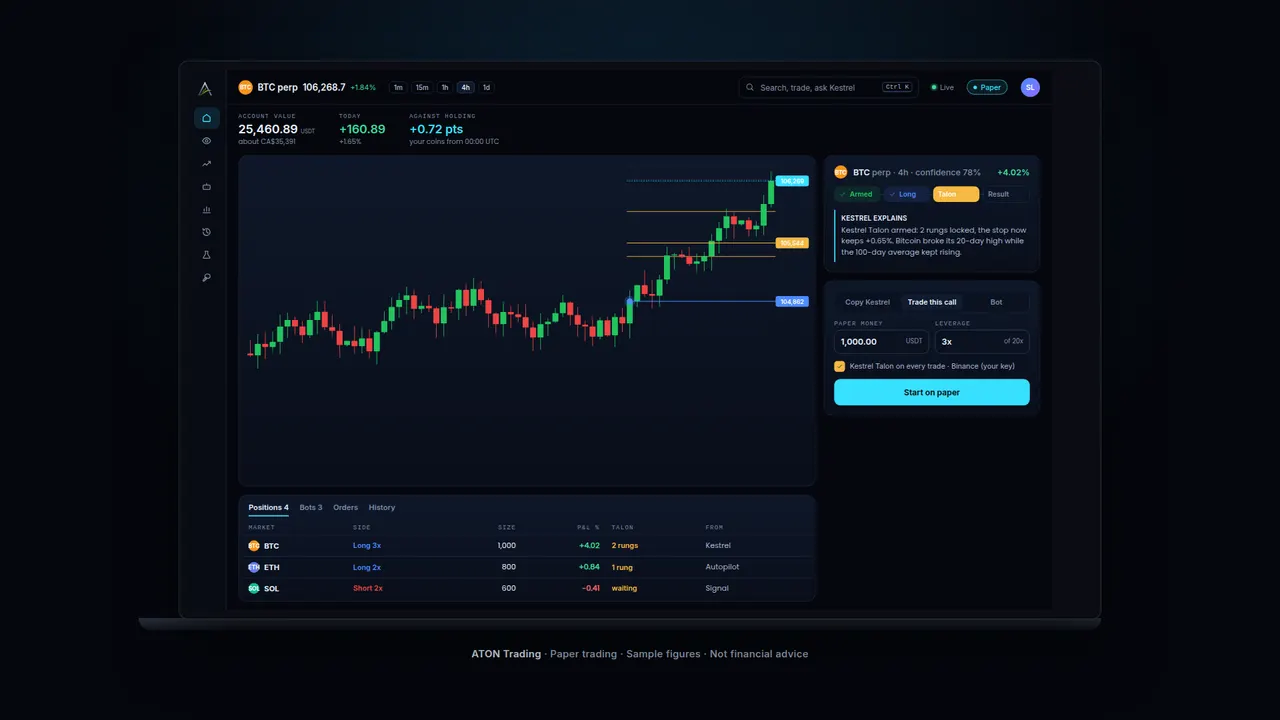
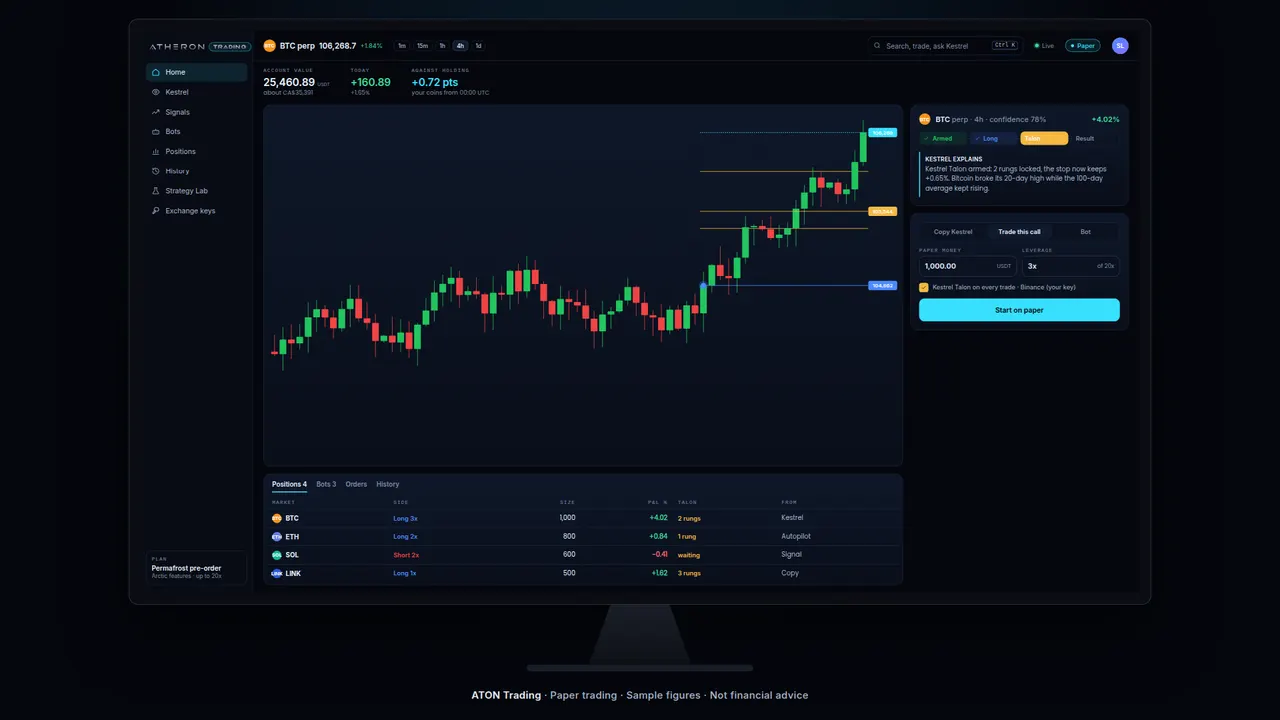
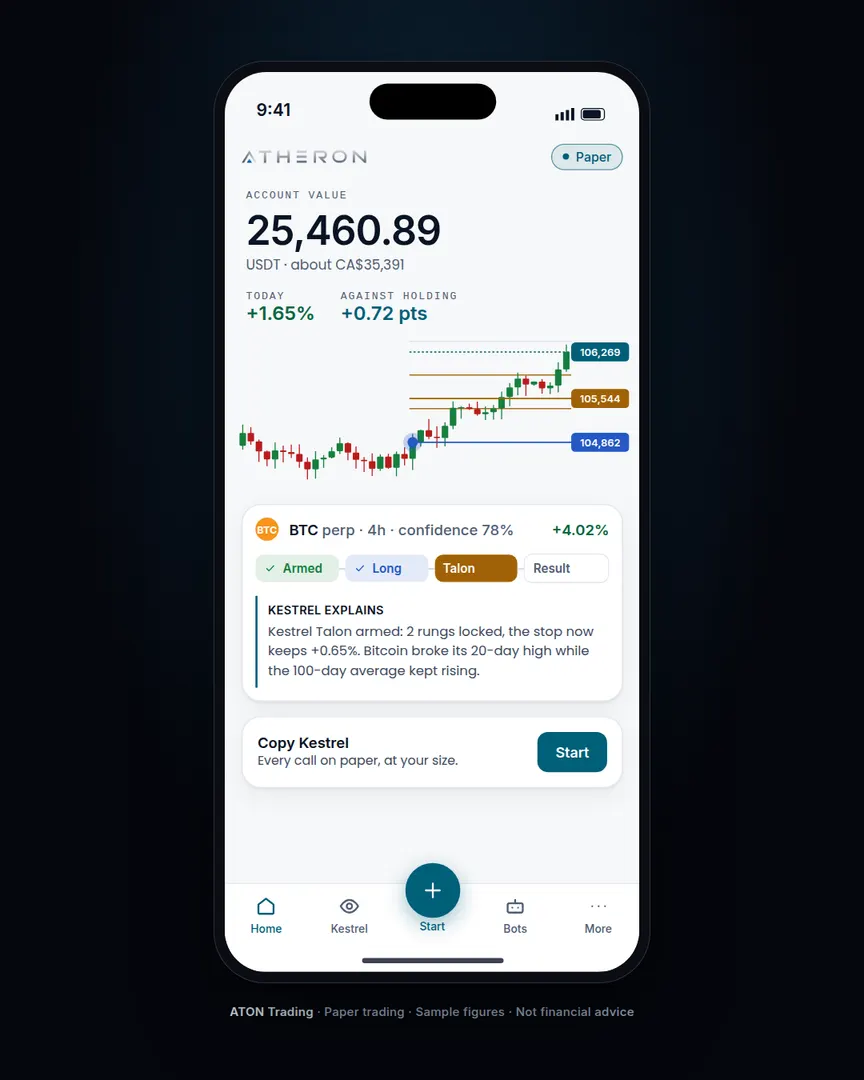
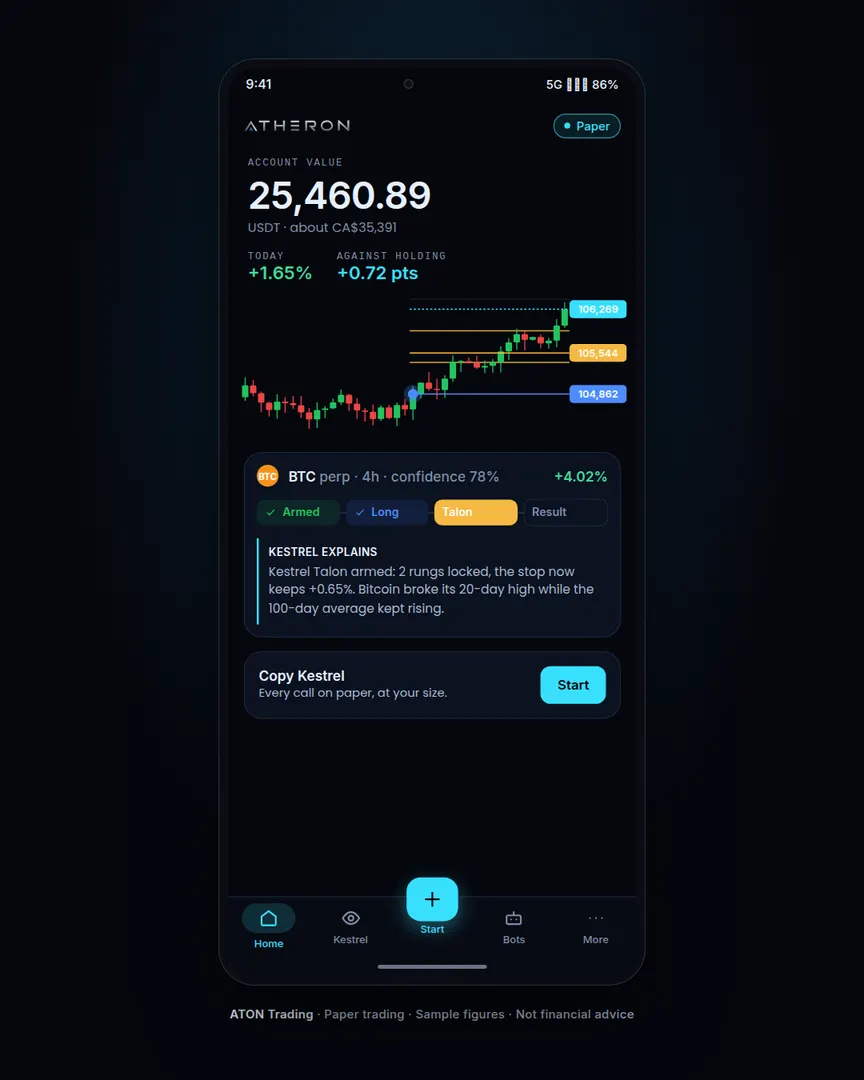
Renderings of the coming trading platform, trading on paper. Every figure in them is a sample, not a result.
The person behind it.
Who leads the work, by name.
Shawn WilsonCEO and Lead Developer
I started Atheron on a simple idea: software that trades for you should never hold your money, should show every decision it makes, and should print its losses as plainly as its wins. That is why everything here runs on paper, in public, until it has earned more than that.
Come and heckle the calls
The control room is open. Free to enter, nothing to buy.
Kestrel learns on members' machines. Members lend their idle machines to Constellation; every job runs on two of them and counts only when the answers agree. The map below is that network, live, each dot a member's machine shown near its closest large city.
Then there is the noisy part: a monthly draw, a programme for creators, and a registry of the people who backed Atheron first. Bring opinions. The anchors read the chat.
Our accounts on Discord, Telegram, X and Bluesky are the same room with different doors. Same people, same bad jokes about bad trades, in whichever app you already have open.
Trained with our community
Kestrel is being trained by 15 members' machines right now.
Legend
- GPU machines
- CPU machines
- Atheron core
- Atheron star
- Market data servers
- Atheron house nodes
- Jobs going out
- Answers coming back
- Market data feeding Atheron star
Live map of the Constellation network: members' machines at their nearest large city, our servers, and the work moving between them. Machines online: 42. Jobs in flight: 14. Verified in the last minute: 6
Every dot is a member's machine at its nearest large city, moved a little and never named.
Monthly draw
Win six months of Aurora. One member wins every month. Free to enter, one entry each.
Creator programme
Earn on what your audience buys, and your audience saves 10%.
Founders' Registry
The people who backed Atheron first, and what they build.
Ask the anchors a question, argue with a call, or just hang out.
Buy your package
The open sale is on. Pick a package and pay at checkout.
First come, first served, until real-money trading goes live.